
Sleep Token & The Sword of Damocles: References in Music
In honor of seeing Sleep Token again this week… Here are my thoughts on one of my all-time favorite Sleep Token songs, "Damocles."

As a mythology nerd (big thanks to Rick Riordan’s “Percy Jackson” series for getting me started), when I saw that a Sleep Token single was named after a myth I wasn’t well acquainted with, I had to check it out. One of the first mentions of the Sword of Damocles was in “Tusculan Disputations” by Roman philosopher Cicero in 45 B.C.. Since then, the phrase “The Sword of Damocles” has been used in pop culture and politics for centuries to exemplify hidden peril or the precarious nature of power. So why did Sleep Token choose to use this comparison?
Who is Sleep Token?
For those who aren’t acquainted with Sleep Token, a brief backstory: Formed in 2016, Sleep Token has taken the Rock and Metal scene by storm. Their album, “Take Me Back to Eden,” was released in May of 2023 and captivated music listeners through a subversive genre-hopping sound. The mysterious nature of the anonymous band has only added to the ravenous fan culture.
Now, some basic band lore, because this band has lots of lore.
The lead singer goes by the name Vessel, and members of the band are known only as the Roman numerals on their masks. The “official” lore is that the band serves Sleep, a deity that appeared to Vessel in a dream. Each song is supposed to serve as a “token” or offering to the deity. Fans have surmised that Vessel may have traded with Sleep to gain fame and wealth while in Sleep’s service.

Sleep Token's use of symbolism is a master class in religious, pop culture, and literary references in lyricism. Additionally, their language on social media seems grounded in a cult-ish/religious base; they refer to their concerts as rituals; their music as offerings. The use of language such as "Sacred Moments, "Prepare to Gather," and "Worship" in their communications leans heavily on religious language.
The band has a knack for creating a large amount of fervor in their fanbase. When announcing the album release of “Even in Arcadia," they employed an alternate reality game, a game designed to take place offline and online to immerse fans in the story, or in this case, promote new music. Fans flocked to these virtual and in-person sites to receive cryptic messages and puzzles. Once solved, it gradually led to teasers for the first singles off the album.
Namesake Myth : The Sword of Damocles
If you are not familiar with the myth, The Sword of Damocles is the story of Dionysius, the tyrant of Syracuse, and his courtier named Damocles. Damocles showered the tyrant with compliments and commented on his sovereign’s happiness.
This tyrant, however, showed himself how happy he really was; for once, when Damocles, one of his flatterers, was dilating in conversation on his forces, his wealth, the greatness of his power, the plenty he enjoyed, the grandeur of his royal palaces, and maintaining that no one was ever happier, “Have you an inclination,” said he, “Damocles, as this kind of life pleases you, to have a taste of it yourself, and to make a trial of the good fortune that attends me?” (Cicero’s Tusculan Disputations, On the Nature of the Gods, On the Commonwealth)
Dionysius ordered Damocles to an extravagant banquet, where he was to be surrounded by great wealth and beautiful servers. Dionysius then had a sword suspended from the ceiling, held only by a single horse hair over Damocles’ head. Once Damocles realized he could not take his eyes off the imminent danger. A singular misplaced breath and the sword would fall.
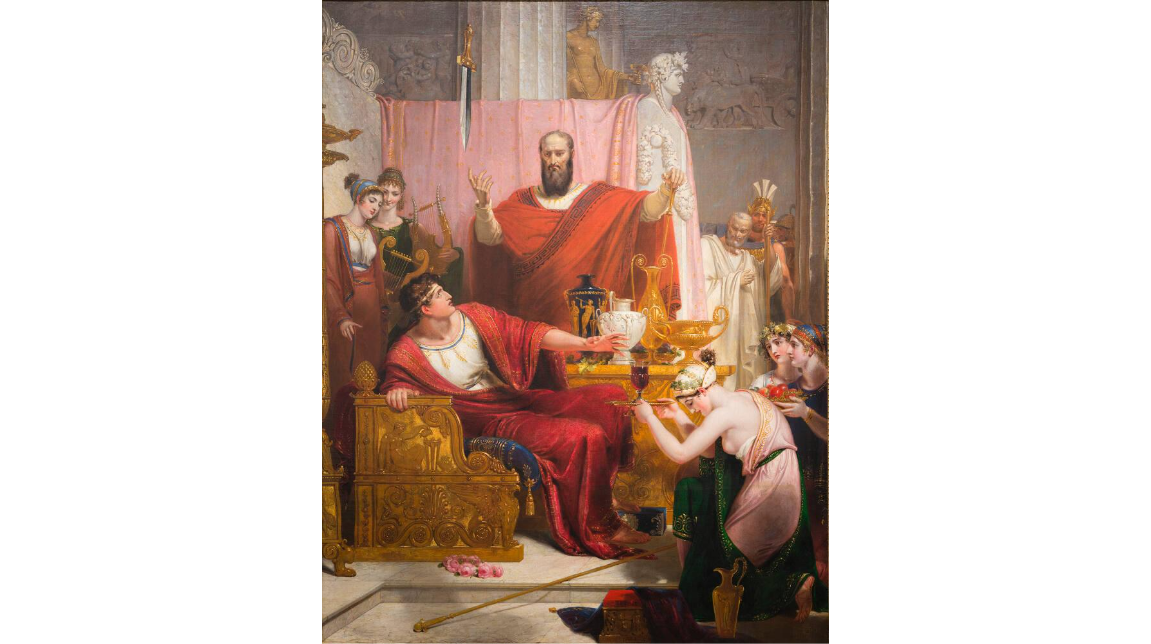
The sword is a powerful metaphor for the fragile nature of power and infamy. In an NPR article entitled, “'Sword Of Damocles' Reference Sometimes Misused”, classics scholar Daniel Mendelsohn provided context to the parable in a political sense. While in a political context, I found that the following quote fully exemplifies the metaphor:
It's not just, oh, something terrible is going to happen, but it's about realizing that what looks like an enviable life, a life of wealth, a life of power, a life of luxury is, in fact, fraught with anxiety, terror and possibly death. …. But the point was all this stuff is meaningless, power, luxury and wealth, and if you know what's good for you, you'll be happy to be a much lesser kind of person.
Damocles:
Listen Here: Damocles by Sleep Token on Spotify
Lyrics Here: Sleep Token – Damocles Lyrics | Genius Lyrics
Sword & Sleep:
The lyrics of "Damocles" exemplify the anxiety of power and fame. While the band is anonymous, individuals have previously tried to expose the band's identities without the members’ permission. Similar to the Damocles of myth, we as a society put individuals in power on a pedestal and then tear them down once they don’t meet our expectations.
In my mind, the first line of the song hits this home: “Well, I've been waking up under blades, blue blossom days.” We, the listeners, may hear the soothing vocals of Vessel and soft piano, but Vessel is waiting for the other shoe to drop. The intro in its entirety shares that the immortality we see in carvings and money (farthings) won’t stop this rise from coming to an end with a sharp misstep. The first pre-chorus highlights this feeling “And it feels like falling into the sea/ From outer space in seconds to me / And I play discordant days on repeat / Until they look like harmony.”
Vessel is just that: a vessel, a conduit for Sleep’s message. The fears he is expressing are human and go beyond martyrdom. “Who will I be when the empire falls? / Wake up alone, and I’ll be forgotten.” These are human fears of being forgotten when this is over and his longing to be infinite.
Think about it.
You have chosen to tell a story anonymously to guard your personal life, or it started as a character. It doesn’t matter either way, but it was to separate from yourself and who you are in your personal life. While you have built a character, people will still try to tear it down.
Who will remember you when you fall? The sword is at your throat, and you can't look away, even as there are riches and infamy laid out to you.
Cannibalistic Nature of the Music Industry:
Now this could be an essay on its own, but I’ll keep it short.
Musicians across all genres have increasingly become more vocal about the mental strains of touring, producing new music, and toxic fan behavior. Fan culture in a capitalistic society is inherently cannibalistic as fans consume more and more, expecting bigger and better from their favorite artist. Vessel seemingly tells the listener these expectations are unsustainable:
Well, I know I should be touring, I know these chords are boring
But I can't always be killing the game
No golden grand pianos or voices from the shadows
Will do anything but feel the same
How can you keep true to your music when you are worried about the expectations of others? The music industry’s nature is to take artists and grind them for their worth, then spit them back out on the other side. Sometimes you are consumed by your fears, as Dionysius was, as he is suspicious of those around him. He has became a tyrant and is consumed by those fears.
Side note: If you are interested, Gabi Belle has a video essay called How Ticketmaster Ruined the Music Industry, which is about the history of ticketing and breaks down where artists actually make money.
Wave like Production:
The production reminds me of a wave with sweeping choruses and soft piano chords that build into a crescendo that crests. One portion I really want to highlight is at timestamp 2:14, where it sounds as if a (maybe cassette?) tape is running out and flipping over. We also have a lyrical change here from “And I play discordant days on repeat / Until they look like harmony” to “Until the tape runs out on me.” It brought me back to the childhood memory of a cassette running out and flipping it over to start over an old country album my grandpa would play in the truck.
Meanwhile, the bridge feels like a gut punch as someone who struggles at times (everyone does). The way Vessel sings... It evokes a feeling of relief as the production returns to the soft piano that the song began with. He is literally begging to be heard as the song crescendos again at the third line of the bridge.
[Bridge]
And nobody told me I'd be begging for relief
When what is silent to you feels like it's screaming to me
Well, nobody told me I'd get tired of myself
When it all looks like heaven, but it feels like hell
The piano rings out softly as the song comes to its conclusion. It is one of those moments on stage that everyone is waiting with bated breath for the final note to finish, to rise in applause. It is a small breath before a thunderous applause. It is the wind that brings the sword down on your neck.
Curtains:
As the album, in its entirety, includes a multitude of references from T.S. Eliot's “The Waste Land” in “Look to Windward,” a biblical reference to “Gethsemane,” and an Alien movie reference in “Emergence.” We are watching the narrative follow a similar structure to the myth of Orpheus and Eurydice, and how Orpheus looks back every time. He can't help but look. Damocles seems to signal that Vessel is faltering between his wants and the wants of his deity. It is consuming him as the sword swings ever closer.
“Damocles” hits hard for me. It is the desperate need to succeed while the emptiness of success sinks in. You fly too close to the sun like Icarus, so your wings melt. You need to strike a careful balance because sometimes what is best for you isn't the vision of success you have in your head. You have to hope that the thread holds or find yourself struck by the sword.
If you are looking for new music, I highly recommend listening to “Even in Arcadia.” It is not necessarily as heavy or whiplash-inducing (as my dad has called it) as "Take Me Back to Eden." But the circular production of "Even in Arcadia" is brilliant. It is a consistent full-length album for me, and I always seem to find a new portion to love every listen.
Thanks for reading! Here’s a picture of Knox:

My Sources:
Myth of Damocles
Damocles | Legend, Sword, & Facts | Britannica
What Was the Sword of Damocles? | HISTORY
'Sword Of Damocles' Reference Sometimes Misused : NPR
Cicero’s Tusculan Disputations, On the Nature of the Gods, On the Commonwealth
Page:1888 Cicero's Tusculan Disputations.djvu/191 - Wikisource, the free online library
Additional Analysis of Sleep Token:
I enjoyed this tremendously. Really well done. Thanks for writing it! Glory to the legion.